One of the most common questions parents ask when they begin homeschooling an autistic child is also one of the most stressful:
“How many hours a day should we be doing school?”
As a special education professional with a master’s degree in educational psychology and an autism homeschool parent myself, I want to offer an answer that is both legally responsible and developmentally honest.
There is no universal number of hours per day that an autistic child must be homeschooled.
Families do need to follow their state’s homeschool laws, but within those legal requirements, the right number of hours is the amount of time your child can engage while regulated and cognitively available for learning.
This is not about doing less.
It’s about doing what actually works.
Start With the Law, Not the Clock
Homeschooling requirements are determined at the state level. Depending on where you live, laws may include:
- instructional days or hours
- required subject areas
- record keeping, portfolios, or evaluations
A reliable, parent-friendly place to look up your state’s homeschool laws is:
Home School Legal Defense Association (HSLDA)
https://hslda.org/legal
Many parents are surprised to learn that most states:
- do not require a traditional 6–7 hour school day
- focus on days per year, not hours per day
- allow flexibility in how instruction happens
This flexibility is intentional and important.

Why “Hours Per Day” Looks Different for Autistic Learners
From an educational psychology perspective, learning time cannot be separated from:
- cognitive load
- working memory capacity
- regulation
- sensory and communication demands
Autistic learners often carry more background cognitive load before instruction even begins. Sensory processing, language processing, emotional regulation, and motor planning all require energy.
When instructional demands exceed what the brain can hold at once, learning doesn’t deepen.
It shuts down.
More time does not equal more learning.
Often, it equals more fatigue.
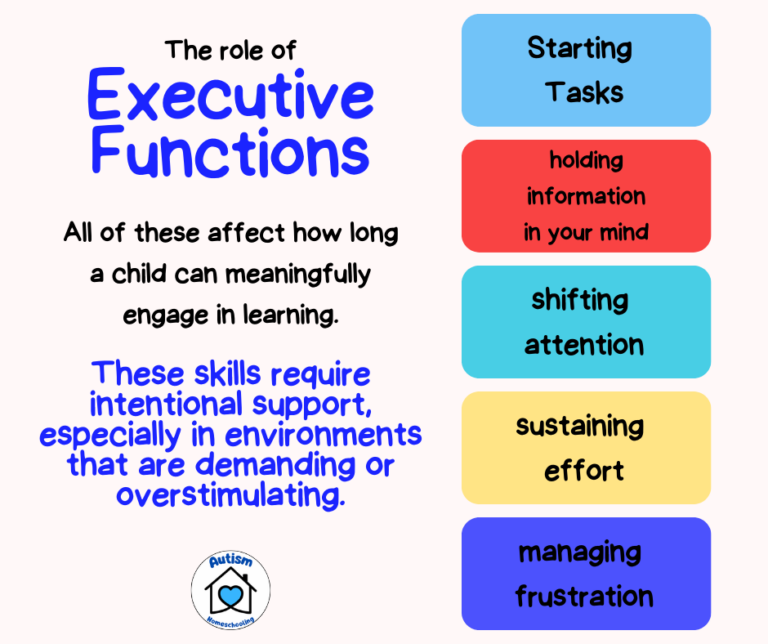
The Role of Executive Function Demands
Skills like:
- starting tasks
- holding information in mind
- shifting attention
- sustaining effort
- managing frustration
All affect how long a child can meaningfully engage in learning.
For many autistic children, these skills require intentional support, especially in environments that are demanding or overstimulating. When demands are too high:
- initiation becomes harder
- transitions take more energy
- learning capacity decreases
- frustration increases
This is not a motivation issue.
It’s a capacity mismatch.
Homeschooling allows parents to adjust those demands in real time.
The Power of 1-to-1 Instruction
One of the most overlooked differences between homeschooling and school-based education is this:
Homeschooled children receive 1-to-1 instruction.
In most school settings:
- one teacher supports many students
- instruction is paced for the group
- feedback is delayed or limited
At home:
- instruction is individualized moment by moment
- pacing adjusts immediately
- supports are embedded naturally
- communication needs are honored
From a learning science standpoint, this reduces unnecessary cognitive load, making instruction more efficient. One focused hour of individualized learning at home can accomplish what takes much longer in a group classroom. Homeschooling does not require replicating school hours. The learning conditions are fundamentally different.
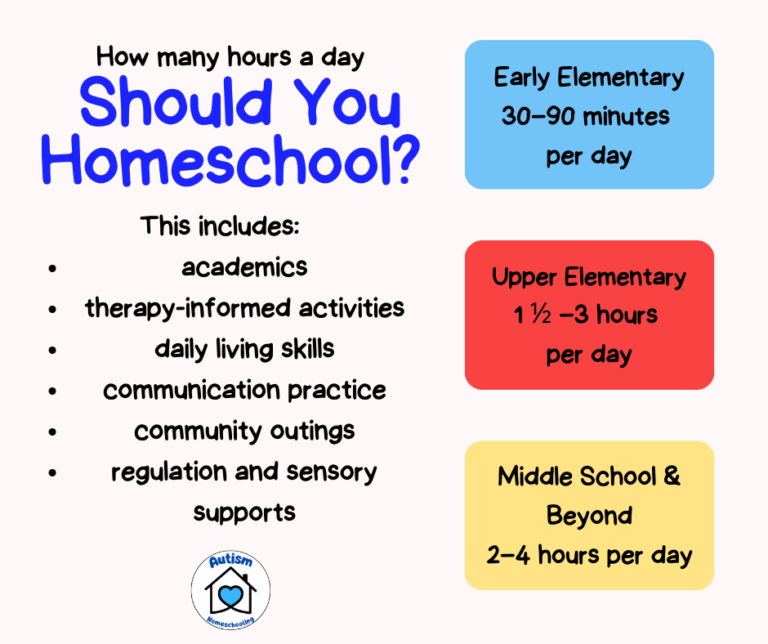
What “Enough Hours” Often Looks Like in Practice
These ranges are informed by research on cognitive load and learner-centered educational design, which shows that learning efficiency, regulation, and individualized pacing matter far more than the length of a traditional school day (Sweller et al., 2011; OECD, 2013).
Early elementary (or similar developmental level)
- 30–90 minutes per day
- broken into short, supported learning blocks
Upper elementary
- 1.5–3 hours per day
- academics mixed with interests and functional skills
Middle school and beyond
- 2–4 hours per day
- projects, life skills, and community learning
Instructional time can include:
- therapy-informed activities
- daily living skills
- communication practice
- community outings
- regulation and sensory supports
These are not extras.
They are part of learning.
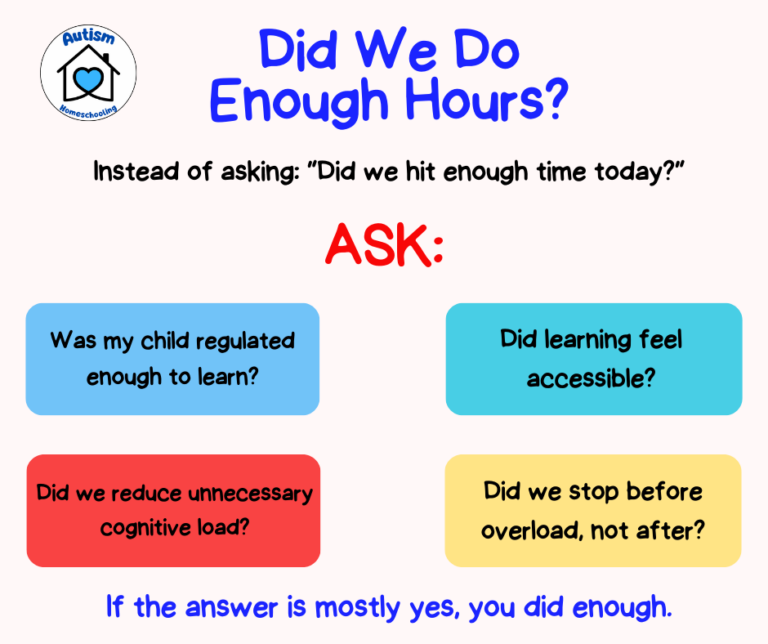
A Better Question Than “Did We Do Enough Hours?”
Instead of asking:
“Did we hit enough time today?”
Try asking:
- Was my child regulated enough to learn?
- Did we reduce unnecessary cognitive load?
- Did learning feel accessible?
- Did we stop before overload, not after?
If the answer is mostly yes, you did enough.
Final Thoughts
Homeschooling an autistic child isn’t about recreating a school day at home.
It’s about creating learning conditions where the brain can actually engage.
Start with the law.
Respect cognitive load.
Honor regulation.
That’s what “enough hours” really means.
If you’re homeschooling an autistic child, you don’t need more pressure.
You need information that respects how learning actually works and honors your child’s nervous system.
That’s the lens behind everything we share at Autism Homeschooling.
We focus on:
-
learning access over seat time
-
regulation before rigor
-
educational psychology and learning science
-
developmentally appropriate, autism-affirming instruction
If this post helped reframe what “enough” looks like in your home, you’re not alone and you don’t have to figure this out by yourself.
You can find Autism Homeschooling here:
🌐 Website: www.autismhomeschooling.com
Amazon: https://www.amazon.com/stores/Autism-Homeschooling/author/B0FXY6HNNJ
🧩 Teachers Pay Teachers: https://www.teacherspayteachers.com/store/autism-homeschooling
🛍️ Etsy: https://autismhomeschooling.etsy.com
We share practical resources, visual supports, and parent-centered guidance designed to reduce overwhelm and make learning feel possible again.
References
OECD. (2013). Innovative learning environments. OECD Publishing.
https://doi.org/10.1787/9789264203488-en
Sweller, J., Ayres, P., & Kalyuga, S. (2011). Cognitive load theory. Springer.